 Русский


1. What is thin-wall bearing?
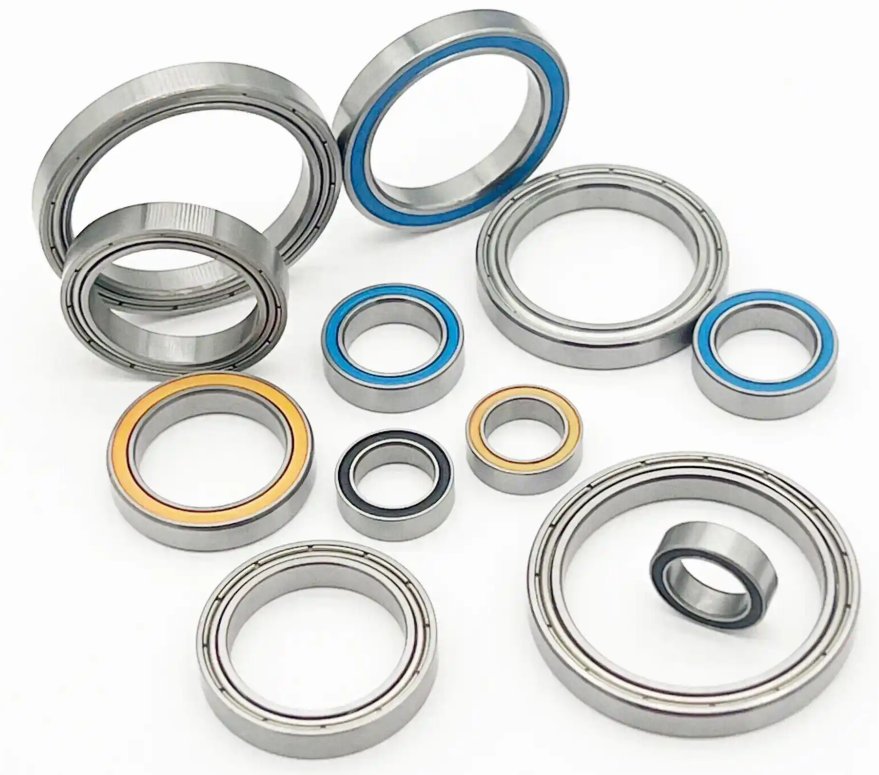
Thin-wall bearings refer to bearings with ultra-thin outer and inner rings. The ratio of the outer diameter to the inner diameter is usually less than 1.25. This structure results in a very small difference between the inner and outer diameters of the bearing, achieving extremely thin bearing walls. While maintaining high rigidity and load capacity, thin-wall bearings offer the advantages of lightweight design and space saving.
Thin-wall bearings are mainly used in applications requiring high precision, high rotational speed, limited space, and lightweight design, such as aerospace, robotics, medical equipment, semiconductor equipment, and precision instruments.
2. Common types of thin-wall bearings:
1) Angular contact thin-wall bearings, such as the 78 series and 79 series, can withstand both axial and radial loads simultaneously, suitable for high-precision applications and used in high-precision equipment and servo systems.
2) Four-point contact thin-wall bearings have four contact points in their internal design, allowing them to withstand radial and axial loads simultaneously. They are used in applications requiring precise positioning and complex load bearing, such as machine tools and rotary tables.
3) Deep groove ball thin-wall bearings have a relatively simple structure, low friction, and small inner and outer ring dimensions, making them suitable for high-speed rotation. They can be used in miniature motors and measuring instruments.
4) Thin-wall cross roller bearings use cross-arranged rollers, offering good load capacity and rigidity. They are widely used in high-precision applications such as machine tools, industrial robots, aerospace equipment, and medical devices.
3. What are the advantages of thin-wall bearings?
1) Lightweight design. Thin-wall bearings have a small cross section thickness, reducing the bearing weight. Their miniaturized and lightweight design effectively reduces the load on the equipment.
2) High precision and high rigidity. Thin-wall bearings are manufactured using high-precision manufacturing processes, meeting the high-precision requirements of the equipment. The materials and processes used provide high structural rigidity, effectively resisting deformation.
3) Space saving. Compared with traditional bearings, thin-wall bearings can provide excellent performance in limited space, optimizing equipment layout.
4) Long lifespan. Thin-wall bearings utilize precision machining processes and high-strength bearing steel, resulting in a low coefficient of friction during operation, reduced energy consumption and extended service life.
Do you have
any question? Call


 Добавить:Промышленный парк прецизионных подшипников в округе Гуантао, провинция Хэбэй.
 Тел:China: +86-635-8550888 Korea Branch: 032-213-8882 Fax:032-213-8883
 Электронная почта:China: bearing@jito.cc
  Веб-сайт:www.jito-bearing.com


